Tuesday, December 23, 2014

Jiangsu Huifeng witnesses YoY increase of 46.23% in net profit in Q3 2014


Jiangsu Huifeng Agrochemical Co., Ltd. (Jiangsu Huifeng) maintained strong
profitability, achieving a YoY increase of 46.23% in net profit, to USD7.99
million (RMB49.08 million) in Q3 2014. According to Jiangsu Huifeng's Q3 2014
report, in the first three quarters of 2014, the company accumulated a net
profit of USD25.46 million (RMB156.47 million) with a year-on-year growth of
43.10%. In Q4 2014, Jiangsu Huifeng expects to make profit . Then it will
achieve a net profit growth of 30%-50% year on year in the whole year (Its net
profit was USD26.54 million – RMB163.13 million in 2013)
, according to Fungicides
China News 1411
on November by CCM.



Compared with net profit, the revenue of Jiangsu Huifeng had a slower
increase in the first three quarters of 2014. In this period, Jiangsu Huifeng
recorded a YoY increase of 14.08% in revenue (USD0.28 billion – RMB1.75
billion), merely one third of that of its net profit. This can be attributed to
the increased gross profit margin of the company.
Cost control was regarded as a main work target by Jiangsu Huifeng.
According to its 2014 semi-annual report, the company's cost of sales in the
first half year of 2014 increased only by 3.73% year on year while its
operating profit increased by 7.93% year on year.
In detail, Jiangsu Huifeng controlled its cost of sales actively in the
aspects of administration, production and distribution.
First of all, its complete production chain ranging from material to
end-user improved the company's cost control. It was purchased from Jiangsu
Jialong Chemical Co., Ltd. who has phosgene resources in May 2014. As a result,
now Jiangsu Huifeng owns more material supply for its pesticide production such
as prochloraz, bromoxynil octanoate, epoxiconazole. Currently, pesticide is
Jiangsu Huifeng's premier business with an annual revenue taking up over 98% of
the total.
Secondly, reasonable management also backs up Jiangsu Huifeng's cost
control effectively in 2014. The company strengthens inside management to make
every step better in the business operation.
Thirdly , the company also optimizes sales mode to improve cost control
and sales performance. As released by Jiangsu Huifeng, the company has already
invested in Nonyi E-commerce Co., Ltd., who is specialized in agricultural
e-commerce in China.
Of course Jiangsu Huifeng considers that marginal cost is one of its
competitive advantages as well. Additionally, the complete production chain,
innovative products and reasonable management are also Jiangsu Huifeng's
competitiveness. The company doesn't only establish production capacities, but
also set up a series of infrastructure such as GLP laboratory, research center,
sales network, marketing center. Jiangsu Huifeng is putting more effort in the
domestic market.
In fact, more and more Chinese agrochemical players pay attention to the
domestic market in recent years with China's economy rocketing up. In the first
half of 2014, the revenue of Jiangsu Huifeng reached about USD104.40 million
(RMB641.63 million), around 60% of which comes from the domestic sales
performance.

Table of Content: 
Fungicides China News 1411
Jiangsu Huifeng witnesses YoY increase of 46.23% in net profit in Q3 2014
Market prices of some fungicide formulations in China, mid-Nov. 2014
Market conditions of corn fungicides in China in 2014
Agricultural e-commerce appears in China
China's fungicides against bacterial diseases
Advice from experts to pesticide enterprises from different perspectives
Enterprises find inspiration in Chinese fungicide market
China's new registrations of fungicide TC, Oct. 2014
Overview of China's fungicide export in Q1-Q3 2014
Import volume of fungicide increases by 20.43% year on year in China,
Q1-Q3 2014

With the development of Chinese agriculture andtheimprovement of China
growers' living standard, China's fungicide market prospect is quite promising;
the import value has exceeded USD117 million in 2009, increasing withaCAGR of
14.03% in the past 9 years. China's fungicide industry is now starving for
capital, advanced technology, and high-quality fungicides. As a big
agricultural country with anarea needing pests prevention of over 4,670 billion
m2 each year, China's demand for fungicide keeps increasing witha CAGR of 3.18%
in the past 8 years. The demand is constantly increasing, due to the frequent
occurrences of diseases and the expanding area stricken by diseases in recent
years. The Fungicides China News brings you the latest information on the
competitiveness analysis of China's fungicide market, including new
legislations, company strategy, investment opportunities, advanced technologies
and quality fungicides that China longs for, crops planting situation and
diseases stricken area, facilitating yoursearch for commercial opportunities in
China's huge market.

About CCM
CCM
is dedicated to market research in China, Asia-Pacific Rim and global market.
With staff of more than 150 dedicated highly-educated professionals, CCM offers Market Data, Analysis,
Reports, Newsletters, Buyer-Trader Information, Import/Export Analysis, and
Consultancy Service.
For more information, please visit http://www.cnchemicals.com
Guangzhou CCM Information Science &
Technology Co., Ltd.
17th Floor, Huihua Commercial & Trade
Mansion, No.80 Xianlie Zhong Road, Guangzhou 510070, China
Tel:   86-20-37616606
This article was provided by CCM, a leading
provider of data and business intelligence on China's chemicals market. Contact
us:
      
-          Facebook: https://www.facebook.com/ccmkate
-          Twitter: https://twitter.com/CCM_Kcomber

For more industry information

China Reaches Free Trade Deal with Australia


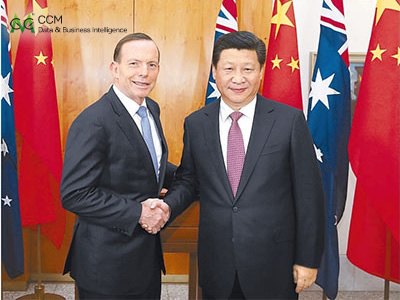
On 17 November, talks between Chinese President Xi Jinping and Australian
Prime Minister Abbott in Canberra saw the two countries finished their free
trade agreement (FTA) negotiation. The agreement contains 2 parts. In the 1st,
all the products covered will enjoy zero-tariff status when exported to
Australia from China. In the 2nd, over 85% of the products covered will be
zero-tariff when exported to China from Australia, this proportion rising to
93% within 4 years and after this 95%
, according to Dairy
Products China News 1411
on November by CCM.


Tariffs on Australian dairy products entering China run up to 20%, but are
now to be removed completely over 4-11 years, dependent on the specific
commodity.
Naturally there has been a positive reception in Australia. In a Melbourne
paper on 20 November one local dairy company - Vi Plus Dairy, operating from
the old Bonlac Toora factory - took out a major front page advertorial offering
their congratulations on the achievement of the FTA!
The FTA will influence trade in several ways:
    Tariff-free trade seems likely
to attract more Chinese dairy enterprises to invest in Australia, where milk
prices are lower and quality higher, a pattern familiar through other
food-security driven investments by the industry in New Zealand and Europe
    Australia will expand milk
output: this has been at a severely reduced level ever since the peak years
either side of year 2000.  As a side
effect, growth in dairy exports to China has the potential to reduce the
country's reliance on the export of rocks and minerals. Gary Helou at Murray
Goulbum, suggests higher payouts to dairy farmers can take the country from 10
billion litres to 20 billion litre. Many in the industry have doubted this
vision for a country which never quite reached 12 billion litres at its peak to
date, but the potential could be there IF wider issues such as water supply
allow; what does appear certain is that Australia will supply more dairy
products to China going forward than in the past.
    New Zealand will face more
competition in exporting dairy products to China. A notable aspect of the deal
which Australian negotiators have been quick to highlight is the absence of the
special safeguard terms present in the New Zealand FTA, which have contributed
to the rush to import early each year in recent times. Likely there will be
moves now by New Zealand to better its deal: a clause in the 2008 agreement
makes legal provision for improvements in trading terms extended by China in any
new trade deal to be automatically applied to its agreement with New Zealand.
    European countries will also
face stepped up competition at a time when milk production is rising and
expected to expand further after the quotas are gone.

Table of Content: 
Dairy
Products China News 1411
South Korea to Expand Exports of Infant Formula to China
Challenges for Chinese UHT Milk Processors
Goat Milk Products Enjoy Huge Potential in China
Dairy Industry's Prosperity Index Increases Slightly in Q3
China Reaches Free Trade Deal with Australia
Danone Becomes Second Biggest Shareholder of Yashili
New Competitors in Infant Formula Market
Royal Dairy Cooperates with Irish Dairy Board
Price of Raw Milk in China Continues to Drop
Vitasoy Launches Premium Soy Milk
Three Infant Formula Processors Acquire Production License
Nanshan Animal Husbandry Builds Dairy Farms and Milk Powder Production
Lines
Guangxi Imports Large Numbers of Cows
Yantang Dairy's IPO Approved
Royal Dairy Sees Growth in Net Profit in Q3 2014
Jiangsu Province Streamlines Test Efficiency on Fresh Milk Imports
Subsidiary of Junlebao Dairy Cooperates with Ireland's Keenan
Milk Deluxe Launch New Product Series
Shaanxi Province Issues Merger and Consolidation Plan of Dairy Industry
Bright Dairy to Take over Tnuva by January

The Dairy Products China News is a monthly newsletter jointly published by
CCM and Orrani Consulting - an overseas dairy expert and a leading consultancy
specialized in the food/drink and ingredient sectors. It combines CCM
International's extensiveknowledgeoftheChinese dairy industry with Orrani's
specialization inthe global dairy sector. Dairy Products China News has an
In-depth and insightful analysis from CCM's experts, accurate market data and
first-hand information and a forecast on the development trend of the dairy
market. It brings you the latest information on new market and company
dynamics, new dairy products and consumption trend, new legislations and
policies and raw milk supply dynamics that are shaping the market.

About CCM
CCM
is dedicated to market research in China, Asia-Pacific Rim and global market.
With staff of more than 150 dedicated highly-educated professionals, CCM offers Market Data, Analysis,
Reports, Newsletters, Buyer-Trader Information, Import/Export Analysis, and
Consultancy Service.
For more information, please visit http://www.cnchemicals.com
Guangzhou CCM Information Science &
Technology Co., Ltd.
17th Floor, Huihua Commercial & Trade
Mansion, No.80 Xianlie Zhong Road, Guangzhou 510070, China
Tel:   86-20-37616606
This article was provided by CCM, a leading
provider of data and business intelligence on China's chemicals market. Contact
us:
      
-          Facebook: https://www.facebook.com/ccmkate
-          Twitter: https://twitter.com/CCM_Kcomber

For more industry information

Friday, December 19, 2014

China’s high-quality phosphorus ore outflows to overseas seriously


In recent years, the international phosphate fertilizer giants taking the Mosaic Company as representative, have accelerated their investment in Morocco, Tunisia, Jordan, Saudi Arabia and other countries with abundant phosphorus ore, obviously intending to raise their influences in the global market through controlling the phosphorus ore as the starting point. However, in contrast to the trend mentioned above, Chinese enterprises still export their phosphate fertilizers made from the high-quality phosphorus ore overseas on the basis of China’s large proportion of medium- and low-grade phosphorus ore and the low utilization rate, which indirectly accelerating the loss of China’s high-quality phosphorus ore.   
According to the statistics from the United States Geological Survey (USGS), the global economic reserves and basic reserves of phosphate rocks (phosphorus ore is the general term for the available phosphate minerals in economy) are 18 billion tonnes and 50 billion tonnes respectively (economic reserves refer to the phosphorus ore with mining cost less than USD35/t and basic reserves refer to those with mining cost less than USD100/t). In fact, over 80% phosphate rocks are clustered in Morocco, the US, South Africa, Jordan and China. Of this, China’s phosphorus ore reserves and basic reserves are 4.1 billion tonnes and 10 billion tonnes, accounting for 27.14% and 21.28% of the global volume respectively. However, there are few high-grade phosphorus ore but rich low-grade phosphorus ore in China and the average grade only reaches 17% phosphorus pentoxide ( P2O5). The high-grade phosphorus ore with over 30% P2O5 only accounts for 8.5% of the total. What's worse, over 90% of medium- and low-grade phosphorus ore cannot be used directly. In view of the analysis conducted by related experts, the current Chinese phosphorus ore may run out within about 20 years.
Phosphorus ore are mainly used in producing phosphate fertilizers and phosphoric acid. With the increasing population worldwide, more and more phosphate fertilizers are in demand to guarantee the food supply. In 2012, the global consumption of phosphate fertilizer was 41.9 million tonnes and it is predicted that the figure will reach 45.3 million tonnes by 2016. According to the preliminary statistics summarized by the China Phosphate Fertilizer Industry Association, China totally output around 16.5 million tonnes of phosphate fertilizers in 2013, of which about 11.88 million tonnes were consumed in the planting industry. Additionally, about 80% phosphorus ore are adopted to manufacture phosphate fertilizers directly or indirectly in China. In recent years, exporting the high-quality phosphate fertilizer is the natural choice to solve China's overcapacity of phosphate fertilizers. It is disclosed that the average export volume of Chinese phosphate fertilizers is around 2.2 million tonnes and a great deal of high-grade phosphorus ore with low-content cadmium drain to the overseas markets. According to data from China Customs, in H1 2014, China exported 596,100 tonnes of monoammonium phosphate, up 201% year on year, 1.27 million tonnes of diammonium phosphate, up 146% year on year, and 493,900 tonnes of triple superphosphate, rising by 116% year on year.
Once China's high-grade phosphorus ore fail to meet the domestic needs of producing phosphate fertilizers, China has to import phosphorus ore or phosphate fertilizers from overseas. At that moment, China will suffer restrictions in the purchase volume and the price of phosphate fertilizers and most imported phosphorus ore or phosphate fertilizers are likely to contain much more cadmium than the Chinese phosphorus fertilizers does. In order to prevent such problems, the Chinese government and enterprises should exploit and utilize the precious phosphorus ore in a reasonable way from now on.
For the Chinese government, firstly, it should improve the access threshold for phosphorus ore exploitation and advance the large-scale and intensive development and utilization of phosphorus ore. Furthermore, it can carry out rational plans, regulate related measures to protect phosphorus ore and control and eliminate unqualified enterprises. Secondly, the Chinese government should intensify the resource exploration and excavate new phosphorus ore resources. The Ministry of Land and Resources of People's Republic of China and related departments should strengthen the exploration capacity for mines, especially for the surroundings and the deep of key mines with favorable phosphoric mineralization to excavate more high-grade phosphorus ore. Thirdly, the Chinese government should intensify supports to the comprehensive utilization technologies of phosphorus ore. China should input more spending to the new technologies, contributing to the energy conservation, emission reduction and consumption reduction in the phosphorus chemical industry so as to improve the level of comprehensively utilizing Chinese phosphorus ore. These new technologies include the technology of producing high-concentrated phosphate compound fertilizers directly based on the medium- and low-grade phosphorus ore and the technology of fully using sulfur and associated resources based on the chemical-process phosphogysum. Fourthly, the Chinese government should encourage enterprises to invest overseas so as to achieve more phosphorus ore with low prices. Through implementing related policies, the Chinese government can encourage large enterprises to take measures such as making investments, jointing capital and merger to establish their own phosphorus ore businesses overseas and participate in the phosphorus chemical asset integration with Morocco, Saudi Arabia and other countries in North Africa and the Middle East in order to collect more cheap phosphorus ore.  
For enterprises, Chinese phosphorus ore enterprises and phosphate fertilizer enterprises should rationally utilize their resources and appropriately export their products abroad. Besides, they should enhance the recovery of phosphorus ore mining and ore dressing, rationally exploit and fully utilize China's limited phosphorus with low-content cadmium and consider to export appropriate volume of phosphate fertilizers under the precondition of ensuring the sustainable supply in the domestic market.  


-          This article was provided by CCM, a leading provider of data and business intelligence on China’s chemicals market. For more information on CCM and China Li-ion Battery E-News, please visit www.cnchemicals.com or contact econtact@cnchemicals.com

-          Facebook: https://www.facebook.com/ccmkate
-          Twitter: https://twitter.com/CCM_Kcomber
Monday, December 15, 2014

Raw material restricting scale economic benefits from industrialization of bio-based materials


In China, starch sugar is the main and almost the only raw material for the production of bio-based materials. When the price of starch sugar maintains a high level for a long time, producing bio-based materials with cheap and abundant straw becomes a potential choice. In terms of the purchasing and storage of straw, its economic benefits are not optimistic. Therefore, using straw instead of starch sugar as raw material would still restrict the scale economic benefits generated from the industrialization of bio-based materials, according to Bio-based  Materials China News 1410 on October by CCM.
Raw material is a significant part of production. Starch sugar is the raw material for many bio-based materials, such as PHA, PBS and PLA. The high price of starch sugar is one of the main reasons for the constant high cost of industrialization of producing bio-based materials through fermentation. As the production capacity of some bio-based materials expands and the release of production capacity maintains in China, the problem of high cost would become severer and severer. Specifically, Zhejiang Hisun Group Co., Ltd. launched a project in Oct. 2014 to expand the production capacity by 10,000 t/a; Guangzhou Kingfa Sci & Tech Co., Ltd. gradually increased its PBS production capacity from 120,000 t/a which was established in 2011 and 2012 (progressively to 200,000 t/a in 2015 as planned); Nanyang Zhongju Tianguan Low Carbon Technology Co., Ltd. expanded its production capacity of polypropylene carbonate (PPC) to 100,000 t/a in June 2014.
Using high-priced starch sugar as raw material in the large-scale production of bio-based materials can not effectively reduce the cost of bio-based materials. Therefore, substituting the high-priced starch sugar with low-priced straw is a new choice for bio-based material manufacturers. As the technology of producing bio-based monomer or bio-based materials with biomass like straw improves (for example, producing bio-based ethyl alcohol and lactic acid through the fermentation of straw), bio-based material manufacturers are competing to exploit straw. Besides, severe weather like haze happens frequently. So the government strictly forbids burning straw. In this way, using straw as the raw material for bio-based materials may usher into an unprecedented development.
In fact, using straw as raw material for bio-based materials may restrict the scale economic benefits generated from the industrialization of bio-based materials. The lightweight straw occupies a large area and costs a lot for transportation. These features hinder the recycling, purchasing and storage of straw. Statistics has it that the annual output of straw in China exceeds 600 million tonnes, but the straw is distributed in dispersed areas, covering eight areas such as Northeast China and the middle and low reaches of Yangtze River. What's more, in recent years, it was more difficult to recycle straw due to the insufficient labor force in rural areas (a lot of farmers take jobs in the cities), which brought about high recycling costs to enterprises. Hence, low economic benefits can be gained from using straw as raw material for bio-based materials. Besides, domestic enterprises can hardly make technological breakthroughs in the production of bio-based monomer and bio-based materials with the fermentation of straw. It seems that it is not the right time for straw to develop as raw material for bio-based materials. 
With the high price of starch sugar, low economic benefits of straw and stagnant technology of raw material transformation, at present, the scale economic benefits generated from the industrialization of bio-based materials in China is still restricted by the raw materials

Biodegradable packaging plastics to continue to lead development of bio-based materials
Investment in bio-based PE worth attention
Bio-based PU has great application potential in automobile field
RMB appreciation may speed up development of bio-based resin
Perspective on development of bio-based materials based on launched corn starch futures
Raw material restricting scale economic benefits from industrialization of bio-based materials
3D printing advances application of bio-based materials in medical field
Market promotion of bioplastics gradually becomes effective
Chinese rubber enterprises pay attention to bio-based materials
Large bio-based monomer project to be built in Anhui's Fuyang City
China Textile Academic Conference closely follows bio-based fibers
COFCO to launch mass production of cellulose ethanol
Taiwan-based Green Miracle proactively building PLA plant
Yun You Into to apply PLA in high-end electronic field
Musashino Chemical establishes company in Jiangxi Province for production of lactic acid and its derivatives.
International Conference of Young Researchers on Advanced Materials held in Hainan Province's Haikou.
Fraunhofer UMSICHT produces 100% degradable water-filter with PLA
China's cassava starch market to stay depressed despite temporary price rises in Q3 2014
Declining imports and increasing exports of PLA to continue in China in Q4 2014
Biomaterials, referring to products using renewable raw materials, have developed rapidly in China in recent years and are expected to have a promising market in the future, though this industry is emerging. Biomaterials are mainly divided into four types in the news: natural bio-based materials, microbial synthetic materials, chemical synthesis of bio-based materials and bio-nylon. Undoubtedly, the application of biomaterials is the trend in the future, thanks to environmental protection, excellent properties, etc. Biomaterials China News includes12 to 14 topics per monthly issue andwill bring you the latest information on the market and company dynamics, new biomaterials products, new biomaterials technology development, new legislations and policies and raw material supply dynamics that are shaping the market.
About CCM
CCM is dedicated to market research in China, Asia-Pacific Rim and global market. With staff of more than 150 dedicated highly-educated professionals, CCM offers Market Data, Analysis, Reports, Newsletters, Buyer-Trader Information, Import/Export Analysis, and Consultancy Service.
For more information, please visit http://www.cnchemicals.com
Guangzhou CCM Information Science & Technology Co., Ltd.
17th Floor, Huihua Commercial & Trade Mansion, No.80 Xianlie Zhong Road, Guangzhou 510070, China
Tel:   86-20-37616606

This article was provided by CCM, a leading provider of data and business intelligence on China's chemicals market. Contact us:      
-          LinkedIn: http://cn.linkedin.com/pub/kcomber-inc/9a/964/2b2/
-          Facebook: https://www.facebook.com/ccmkate
-          Twitter: https://twitter.com/CCM_Kcomber

Hubei Taisheng: capacity of glyphosate technical expected to reach 130,000 tonnes in 2015

Summary: Hubei Taisheng will build a new production line for 60,000 t/a glyphosate technical with a total investment of about USD111.14 million. The construction period is 12 months. By the end of next year, this construction will be finished and be put into production. After that, Hubei Taisheng's production capacity of glyphosate technical will reach 130,000 t/a, ranking the first in China and the second in the world, according to Glyphsoate China Monthly Report 1410 on October by CCM.


On 15 Oct., 2014, Hubei Xingfa Chemicals Group Co., Ltd. (Hubei Xingfa) proclaimed that its holding subsidiary, Hubei Taisheng Chemical Co., Ltd. (Hubei Taisheng) will carry out a glyphosate technical production project of 60,000 t/a (phase I) in the Yichang Fine Chemical Industrial Park in Yichang City of Hubei Province. This project serves as the first phase of the expansion project of 100,000 t/a glyphosate technical production by adopting the pathway of glycine. The construction period of the first phase covers 12 months. When Hubei Taisheng finishes its first phase of construction by the end of next year (2015), its production capacity of glyphosate technical will reach 130,000 t/a, ranking the first in China as well as the second in the world.
The first-phase project includes constructing sewage treatment stations, salinity wastewater treatment devices as well as 90,000 t/a phosphorus trichloride, 60,000 t/a dimethyl phosphite, 60,000 t/a glyphosate technical, and 60,000 t/a methyl chloride recycling devices. The total investment of the first phase is USD111.14 million (RMB683.93 million). The main-body project of glyphosate will cost USD77.96 million (RMB479.73 million); the cost of land expropriation is USD16.49 million (RMB101.47 million). The investment of device expansion for the glyphosate salinity wastewater treatment adds up to USD13.43 million (RMB82.65 million). All the funding need to be collected by Hubei Taisheng itself.
The first-phase project is significant to both Hubei Taisheng and Hubei Xingfa, because it will probably bring enormous economic benefits to Hubei Taisheng. After the project is put into production, it is estimated that Hubei Taisheng can make a revenue of USD273.49 million (RMB1.68 billion), a pretax profit of USD44.99 million (RMB276.89 million) and a net profit of USD38.24 million (RMB235.35 million). Through the first-phase project, Hubei Xingfa could further coordinate itself with subsidiaries or joint stock companies in the Yichang Fine Chemical Industrial Park in producing ionic membrane caustic soda, aminoacetic acid, and organic silicon, to create an all-win situation ultimately.
According to the present and the future situation of the glyphosate demand, it is still unknown whether such a powerful capacity of glyphosate production can be fully released. After the first-phase project is put into production, Hubei Taisheng's full production capacity of 130,000 t/a must be influential to the glyphosate market in China. Hubei Xingfa is also concerned about this. It proclaimed, Hubei Taisheng would bear a certain sales pressure due to its large scale of production capacity of glyphosate. Meanwhile, the setting up of glyphosate projects in succession in parts of China might impact the price of glyphosate, leading to Hubei Taisheng's failure to reach its anticipated goal of economic benefits of the expansion project.
The capital needed for the first-phase project is a big challenge for Hubei Taisheng. Nevertheless, according to the profit made in the past plus the supports offered by its parent company Hubie Xingfa, the capital will not be a problem for Hubei Taisheng.
The business of Hubei Taisheng has been moving on smoothly and making profits. Particularly in 2013, Hubei Taisheng made a revenue of USD360.61 million (RMB2.22 billion), and a net profit of USD76.26 million (RMB469.29 million). In the first half of 2014, its revenue was USD189.44 (RMB1.17 billion), and the net profit was USD30.47 million (RMB187.48 million). The business of Hubei Taisheng is predicted, based on the picture of glyphosate industry in the second half of 2014, to remain the same or slightly excess that of 2013.
Hubei Xingfa is always attaching importance to Hubei Taisheng and providing supports to its operation, especially in the loan guarantee. On 16 Oct., 2014, Hubei Xingfa announced that it will provide a joint and several liability guarantee of USD65 million (RMB400 million) for Hubei Taisheng in Xiaoting Branch of Agricultural Bank of China.
One of the advantages of the Hubei Taisheng's expansion project of glyphosate technical is the raw material supply (Refer to Glyphosate China Monthly Report 1404: Advantages of Hubei Xingfa acquiring 51% shares of Hubei Taisheng for detailed information). Therefore, the most advantageous competence of Hubei Taisheng shall be the lower cost.
The establishment and expansion of production capacity of glyphosate technical has always been a popular topic in China. CCM will continue to report the Hubei Taisheng's progress of the glyphosate technical project, and the information on the establishment, reconstruction and expansion of the production capacity of glyphosate technical of other companies.
Zhejiang Wynca's subsidiary to draft national standards for by-product of glyphosate: sodium pyrophosphate
Sichuan Fuhua and Jiangxi Jinlong to draw national standards for by-product of glyphosate: sodium phosphate dibasic dodecahydrate
Monsanto expected to sell anti-glyphosate soybean seed in 2016
Nufarm's glyphosate gains registration on pre-harvest oilseed rape
Raw material shed of Shandong Binnong explodes on 29 Sept., 2014
Statement of Shandong Binnong on 9•29 explosion
Shandong Binnong's revenue in first three quarters of 2014 reaches USD268.12 million
Zhejiang Wynca to provide entrust loans of USD14.62 million to joint-stock company
Hubei Taisheng: capacity of glyphosate technical expected to reach 130,000 tonnes in 2015
Hubei Taisheng to purchase relevant assets of glyphosate salinity wastewater treatment project of Hubei Yuerui
Yichang Jinxin to launch 40,000 t/a glycine expansion project
China's demand for glyphosate TC to stay stable over next two years
Environmental protection capacity to become new core competence of glyphosate manufacturers
Ex-works price of glyphosate technical decreases by 4.27% in Oct. 2014 MoM
Export volume of glyphosate technical decreases by 5.62% in Aug. 2014 MoM
China PMIDA market in first work week of Oct. 2014 (8 Oct.-11 Oct.)
China glycine market in first work week of Oct. 2014 (8 Oct.-11 Oct.)
China DEA market in first work week of Oct. 2014 (8 Oct.-11 Oct.)
China IDAN market in first work week of Oct. 2014 (8 Oct.-11 Oct.)
China yellow phosphorus market in first work week of Oct. 2014 (8 Oct.-11 Oct.)
China phosphorus trichloride market in first work week of Oct. 2014 (8 Oct.-11 Oct.)
China isopropylamine salt market in first work week of Oct. 2014 (8 Oct.-11 Oct.)
China paraformaldehyde market in first work week of Oct. 2014 (8 Oct.-11 Oct.)
China chloromethane market in first work week of Oct. 2014 (8 Oct.-11 Oct.)
China methylal market in first work week of Oct. 2014 (8 Oct.-11 Oct.)
China is currently the largest glyphosate supplier in the world, with low production costs anda good chemical production foundation. The dynamics of China's glyphosate greatly impact the global supply structure. Over 80% of theglyphosate produced in China is exported to more than 20 destinationsworldwide. Despite its large output and capacity, China's glyphosate industry has many shortcomings, includingovercapacity, dispersed production, few overseas registrations, poor environmental protection awareness, lack of governmental supervision, inefficient production technology, etc. Changes in China's glyphosate industry have not only been considerable, but also frequent, puzzling both outsiders and insiders,ignoring where to go next. That's because the influencing factors are many and changing frequently, thus making it highly necessary for timely update and close follow-up of the dynamics in this industry. The Glyphosate China Monthly Report brings you the latest information and in-depth analysis on market trends, supply and procurement opportunities in raw materials and intermediates, technology process, price updates, new policies and company dynamic, etc.
About CCM
CCM is dedicated to market research in China, Asia-Pacific Rim and global market. With staff of more than 150 dedicated highly-educated professionals, CCM offers Market Data, Analysis, Reports, Newsletters, Buyer-Trader Information, Import/Export Analysis, and Consultancy Service.
For more information, please visit http://www.cnchemicals.com
Guangzhou CCM Information Science & Technology Co., Ltd.
17th Floor, Huihua Commercial & Trade Mansion, No.80 Xianlie Zhong Road, Guangzhou 510070, China
Tel:   86-20-37616606

This article was provided by CCM, a leading provider of data and business intelligence on China's chemicals market. Contact us:      
-          LinkedIn: http://cn.linkedin.com/pub/kcomber-inc/9a/964/2b2/
-          Facebook: https://www.facebook.com/ccmkate
-          Twitter: https://twitter.com/CCM_Kcomber